
Good corporate event transportation means every guest, speaker and executive reaches the venue on time, in the right vehicle, without asking anyone how. For executive groups, VIP arrivals and Boston airport pickups, that usually means private chauffeured sedans and SUVs, booked against a written schedule and tied to flight arrival times. We run that kind of corporate transportation in Boston, including flight-tracked Logan pickups, multi-vehicle coordination and corporate billing.
This guide is for the person who has been handed the logistics: an executive assistant, office manager, event planner or the executive who is organizing it themselves. It covers the options, how to build the plan, what to check in a provider, and what goes wrong.
TL;DR
- Match the vehicle to the guest. Executives, speakers and VIPs are best served by private sedans and SUVs with a chauffeur. Large groups moving on a fixed loop are a different job.
- Build the plan from the arrival list: names, flights, hotels, venue, and the time each person must be seated.
- Tie airport pickups to flight tracking, so a delayed flight moves the pickup instead of stranding the guest.
- Vet the provider on licenses, insurance, 24-hour contact, cancellation terms and driver standards before you sign.
- Put routes, times and pickup points where guests will actually see them, and name one coordinator who answers the phone on event day.
Table of Contents
- What corporate event transportation actually covers
- The main transportation options and how they differ
- Why executive groups are best served by private chauffeurs
- How to plan event transportation step by step
- What to check before you book a provider
- What affects the price of a quote
- A worked example: a two-day leadership offsite
- Common mistakes in corporate event transportation
- Where weddings and other group events fit
- Booking corporate event transportation with us
- FAQ
- Sources
What corporate event transportation actually covers
The phrase stretches across several different jobs, and mixing them up is the first planning mistake. A board dinner with eight senior guests, a 400-person conference with attendees in three hotels, and a two-day roadshow with a CEO moving between six meetings are all "event transportation." They need different vehicles and different people running them.
Think of it as four moving parts:
- Arrivals and departures. Getting guests between the airport or train station and the hotel.
- Hotel to venue. The daily movement, often to a fixed start time.
- Between sessions. Offsite dinners, client visits, site tours.
- VIP and executive movement. Speakers, leadership and key clients who cannot be late and should not be waiting on a curb.
Most events need a mix. The mistake is solving all four with the same vehicle type because it was easiest to quote.
The main transportation options and how they differ
| Option | Best for | Strength | Watch for |
|---|---|---|---|
| Private chauffeured sedan or SUV | Executives, speakers, VIPs, small groups | Door-to-door, flexible timing, a professional waiting at arrivals | Cost per person rises as groups grow |
| Multiple chauffeured vehicles | Leadership teams, roadshows, mid-size delegations | Everyone arrives on their own schedule, with one coordinator | Needs clear dispatch and a single point of contact |
| Scheduled shuttle loop | Large attendee counts between hotel and venue | One vehicle moves many people on a fixed circuit | Guests must adapt to the timetable |
| Charter coach or motorcoach | Large groups traveling together | Highest capacity per vehicle | Fixed departure times, parking and staging at the venue |
| Party bus | Social events and celebrations | Atmosphere | Different purpose from business travel |
| Ride-hailing credits | Casual, low-stakes trips | Easy to hand out | Variable vehicle, driver and wait time |
The party bus versus charter bus question comes up often. In general terms, a charter bus is a transit vehicle for moving a group from A to B, while a party bus is built for social atmosphere. Neither is the tool for moving a CEO from Logan to a 9 a.m. meeting.
The dividing line is who is riding and what a late arrival costs. If a guest being 20 minutes late would embarrass the company, that guest needs a private vehicle with a dedicated driver. If a hundred attendees are doing a hotel-to-venue run every 15 minutes, a shuttle loop does the work.
Why executive groups are best served by private chauffeurs
For the people who matter most to the event's outcome, a chauffeured vehicle removes the variables. There is no app to open, no surge, no driver circling an arrivals level, and no guest wondering which car is theirs.
Here is what that looks like with our service in Boston:
- Flight tracking on Logan pickups. Your chauffeur follows the actual arrival, so an early landing or a two-hour delay does not turn into a missed connection with a car.
- Meet-and-greet. The guest is met by a vetted, uniformed chauffeur rather than left to find a vehicle. That matters most for a first-time visitor or a client you want to impress.
- An on-time guarantee. Timing is the entire point of event transport, so we stand behind it.
- Luxury sedans and SUVs. You can see the fleet of executive SUVs and sedans before you decide who rides in what.
- Available 24/7. Events do not keep office hours. Red-eye arrivals and late-night departures are covered.
For companies booking repeatedly, we also offer dedicated account management and corporate billing, so one invoice covers an entire event instead of a stack of individual receipts for finance to reconcile.
How to plan event transportation step by step
1. Start from the guest list, not the vehicle
Build one sheet before you ask for a quote. For every traveler, record name, company, arrival flight and airport, hotel, departure flight, and any mobility needs. Mark who is a VIP. Mark who is traveling together. A planner who has this sheet gets accurate quotes. A planner who does not gets estimates that fall apart when the final list arrives.
For the number of vehicles, count the arrival waves. If fifteen guests land between 2 p.m. and 4 p.m., you probably do not need fifteen cars. You need enough vehicles to cover the overlaps, and a dispatcher who can sequence them. That is where a provider with multi-vehicle logistics experience earns its fee.
2. Decide the schedule backward from the event
Work back from the time each person must be seated. A keynote speaker should reach the venue well before the session, not at it. Add buffer for Boston traffic, tunnel and bridge delays, and loading luggage. Then set pickup times at the hotel and, for arrivals, define what happens if a flight is late.
Planners are advised to settle shuttle schedules and drop-off locations early, and to publish routes, schedules and signage on the event website, mobile app, hotel lobbies and pickup points, according to Executivevents' guidance on event transportation. The same principle applies to private cars: guests should receive their pickup time and chauffeur details before they land, not after.
3. Plan for accessibility from registration
Ask about mobility needs in the registration form rather than on the day. The same guidance recommends collecting accessibility needs through the registration vendor so that accessible vehicles can be added to the plan. Whichever vehicle type you use, confirm in writing that an accessible option is available for any guest who needs it, and tell your provider the specifics early.
4. Fix pickup points and the single point of contact
Choose one pickup spot at each hotel and venue, check that the vehicles can legally stop and wait there, and name it on every communication. Then designate one coordinator, on your side and the provider's, reachable by phone throughout the event. When a speaker's flight is rerouted at 6 a.m., you want one call, not a chain of emails.
5. Confirm, then reconfirm
Send the final manifest to your provider a few days out, and confirm again the day before. Guest lists change right up to the event. Agree in advance how last-minute additions, changes and cancellations are handled and what they cost.
What to check before you book a provider
A provider's polish in a sales call tells you little. A checklist tells you more. Executivevents' RFP checklist for hiring a transportation company lists the items below, which are a useful base for any corporate event (source):
- Fleet size, and the age and condition of the vehicles
- Capacity per vehicle
- Amenities
- Accessible vehicle availability
- Safety track record
- Insurance coverage and licenses
- Cancellation policy
- Driver uniforms
- 24-hour contact availability
- Any attendant costs and food and beverage rules
For private chauffeur service, add questions about how drivers are vetted, how flights are monitored, what happens when a vehicle has a problem, and whether there is a written on-time commitment. Our chauffeurs are vetted and uniformed, our vehicles are maintained luxury sedans and SUVs, and the on-time guarantee is part of the service.
Ask also how the invoice will look. Finance teams prefer a single consolidated bill with a clear breakdown per trip, and corporate billing is built for exactly that.
What affects the price of a quote
There is no honest flat number for event transportation, because the price depends on the job. A realistic quote request should state:
- Date and time. Peak dates, holidays and late-night hours often price differently.
- Vehicle type and count. An SUV costs differently from a sedan, and ten vehicles are a different job from two.
- Duration. Point-to-point transfers and hourly hire are priced on different logic. Hourly hire suits days when a leader has several stops and the schedule moves.
- Distance. A Logan-to-downtown transfer is not a trip from Boston to another city. For longer trips, a city-to-city car service is the right format.
- Waiting time. Events run late. Ask how waiting is handled.
- Special requirements. Extra stops, luggage volume, accessibility needs.
The more complete your guest sheet, the tighter the quote. We do not publish fixed prices because every itinerary is different, so the quickest route is to send the manifest and get a quote built for it.
A worked example: a two-day leadership offsite
Imagine a 12-person leadership team flying into Logan for a two-day strategy offsite at a downtown hotel, with a client dinner on the first evening.
- Arrivals. Eight guests land between noon and 3 p.m. on three flights, four land in the evening. Three chauffeured SUVs cover the first wave with staggered pickups, each tracked against the actual landing time. The evening four share a second pair.
- Day one. The hotel is walkable to the venue, so no daily shuttle is needed. The client dinner is across town: two SUVs leave together at a set time, with the chauffeurs waiting through the dinner.
- Day two. The CEO has a morning media interview, then lunch with a client, then a flight home. She books an hourly chauffeur so the schedule can flex if the interview runs long.
- Departures. Pickups are set backward from each flight, with traffic buffers, and confirmed the night before.
- Billing. One invoice, one reference number, one line item per trip.
Nobody in that plan opened a ride app, searched for a curb, or called the planner to ask where the car was.
Common mistakes in corporate event transportation
Booking by vehicle, not by guest. Starting from "we need two vans" hides the real problem, which is timing, not seats.
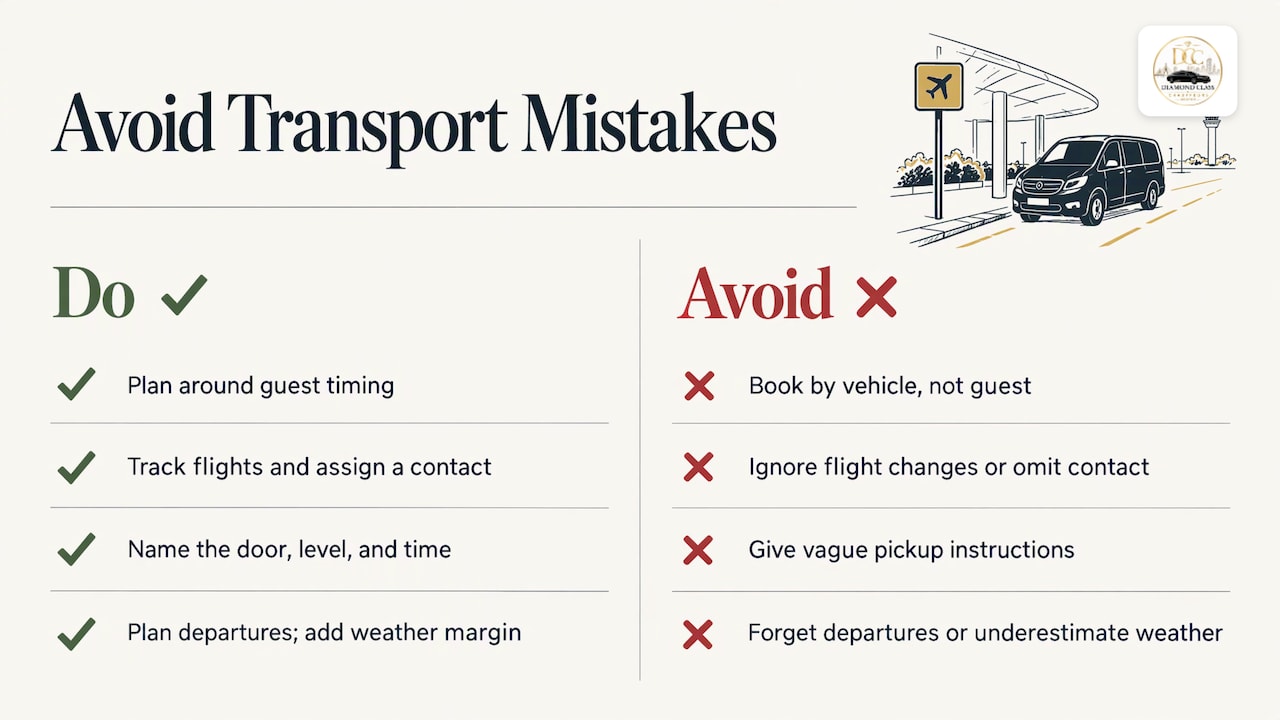
Ignoring the flight. A pickup scheduled for the booked arrival time fails when the flight is early or late. Flight tracking exists to prevent exactly this.
No contact on event day. The weakest point in many events is not the vehicle but the absence of a human who can solve a problem at 5 a.m.
Vague pickup instructions. "Meet at the hotel" is not an instruction. Name the door, the level, the time.
Forgetting departures. Teams plan arrivals carefully and then improvise the exit, when everyone is tired and flights are fixed.
Underestimating weather. In New England, a winter storm can reshape the schedule overnight. Build in extra margin and a way to reach every guest quickly.
Where weddings and other group events fit
The same logic applies beyond the boardroom. Couples planning a wedding face a version of the same problem: guests arriving from out of town, a ceremony with a fixed start, and a family who does not want to worry about cars. Our wedding transportation follows the same discipline, with a schedule built backward from the ceremony. If you are comparing formats, the difference is mostly tone: corporate events prize discretion and punctuality, weddings add presentation.
Booking corporate event transportation with us
We cover Boston and New England with private chauffeurs for airport transfers, corporate travel and roadshows, hourly hire, weddings and city-to-city trips. For events, the practical offer is this: flight-tracked Logan pickups with meet-and-greet, vetted and uniformed chauffeurs, luxury sedans and SUVs, an on-time guarantee, and for corporate customers dedicated account management, corporate billing and coordinated multi-vehicle logistics.
See the full range on our chauffeur services page, or start with the Logan Airport car service if arrivals are the hardest part of your event. You can book online or by phone, and send your guest list for a quote.
FAQ
How far ahead should I book event transportation?
Book as soon as dates and the venue are fixed, then update the manifest as the guest list firms up. Early booking secures vehicles on busy dates and gives your provider time to plan arrival waves. Confirm final details a few days before and again the day before the event.
Do I need one vehicle type for the whole event?
No. Most events mix formats: private chauffeured cars for executives and VIPs, and a different arrangement for large groups on a fixed loop. Decide by who is riding and what lateness would cost, not by what is easiest to quote.
What should I send a provider to get an accurate quote?
Send the date, pickup and drop-off locations, flight numbers and arrival times, number of passengers, vehicle preferences, hours of service needed and any accessibility requirements. Complete information produces a quote that holds on event day.
How do chauffeurs handle flight delays?
Our chauffeurs track the flight on Logan pickups, so the pickup follows the actual arrival rather than the scheduled one. Guests are met on arrival by a uniformed chauffeur, which keeps the handoff simple even when the schedule moves.